


Dealing with a disrespectful grown child can be one of the most heart-wrenching experiences for any parent, leaving you feeling hurt, confused, and unsure of how to respond. The good news is there are many effective strategies for managing and improving your relationship with your grown child. Start by setting clear boundaries and communicating your expectations calmly and respectfully. It’s crucial to lead by example, showing the kind of respect and behavior you wish to receive in return. Additionally, actively listen to your child’s perspective and apologize for things you may have done wrong. Seeking professional support, whether through individual, family, or group therapy, can also provide valuable tools and guidance.
ChoosingTherapy.com may earn a commission from the companies whose services are linked on this page.
Parenting Is Stressful and Challenging!
Get support. BetterHelp has over 30,000 licensed therapists who provide convenient and affordable online therapy. BetterHelp starts at $65 per week and is FSA/HSA eligible by most providers. Take a free online assessment and get matched with the right therapist for you.
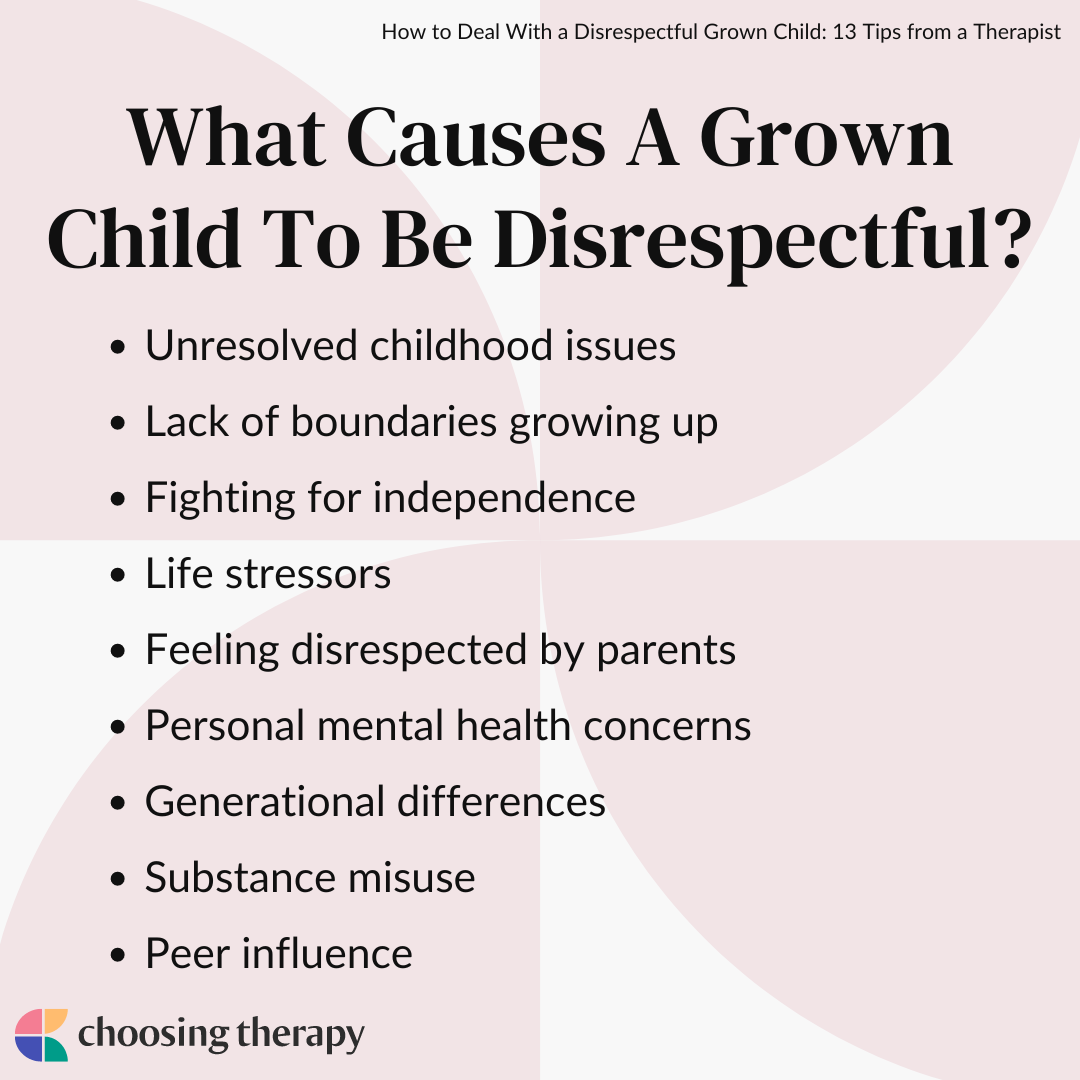
What Causes A Grown Child To Be Disrespectful?
It’s not uncommon for parents to feel hurt or confused when their adult children act disrespectfully. There can be many underlying reasons for this behavior, including a lack of boundaries growing up, generational differences, and mental health struggles. Understanding them can help address and improve the relationship.
Possible reasons for disrespectful behavior in adult children include:
- Unresolved childhood issues: When someone grows up in a dysfunctional family environment, these issues can carry over into adulthood. For example, if a child felt that their parents were too strict or didn’t show enough affection, they might harbor resentment. As adults, this unresolved resentment can lead them to act out disrespectfully because they still feel hurt or misunderstood by their parents.
- Lack of boundaries growing up: If a parent never set clear boundaries when the child was growing up, the grown child might not understand what respectful behavior looks like. This can result in them not recognizing when their actions are hurtful or inappropriate. Additionally, if disrespectful behavior was never corrected during childhood, the grown child may continue those behaviors into adulthood, thinking they are acceptable.
- Fighting for independence: As children grow up, they naturally seek to become more independent and make their own decisions. However, if parents continue to treat them like children, this can create tension. The grown child might react by being disrespectful as a way to assert their independence and push back against what they perceive as control.
- Life stressors: Life can be stressful, and pressures from work, relationships, or financial issues can impact how a person behaves. If a grown child is dealing with a lot of stress, they might take out their frustrations on their parents, acting disrespectfully because they are overwhelmed and unable to cope effectively.
- Feeling disrespected by parents: Respect is a two-way street. If grown children feel that their parents don’t respect them—perhaps by dismissing their opinions or choices—they might respond with disrespect. This can create a cycle where both parties feel disrespected and continue to treat each other poorly.
- Personal mental health concerns: Mental health conditions such as depression, anxiety, or personality disorders can affect how someone interacts with others. These conditions can make it harder for a person to manage their emotions and behavior, sometimes resulting in disrespectful actions towards their parents.
- Generational differences: Different generations often have varying values and beliefs, which can lead to misunderstandings and conflicts. For example, older generations might value tradition and authority, while younger generations might prioritize individuality and equality. These differences can cause friction and disrespectful behavior if not acknowledged and addressed.
- Substance misuse: Abuse of alcohol or drugs, or a possible substance use disorder, can significantly impact a person’s behavior and relationships. If a grown child is struggling with substance misuse, it can impair their judgment and self-control, often leading to disrespectful or hurtful interactions with their parents.
- Peer influence: Peer pressure can sometimes influence a person to act in ways that they would not otherwise. If a grown child is surrounded by friends or a partner who disrespects their parents, they might adopt similar behavior.
13 Ways to Deal With a Disrespectful Grown Child
Addressing disrespectful behavior from an adult child is key to keeping family dynamics healthy. Handling disrespect from adults is different than dealing with it in children. With kids, the focus is on teaching and guiding them toward appropriate behavior. On the other hand, with disrespectful adult children, it’s about finding a balance between setting boundaries and understanding the underlying reasons for their behavior. It’s important to recognize past influences, respect their independence, and have open, empathetic conversations.
Here are thirteen ways to respond to a disrespectful grown child:
1. Take a Deep Breath Before Responding
It can be natural for you to want to respond to disrespect with the same tone as your grown child, but this will not help the situation. Taking a breath will allow you to regain composure rather than respond with anger.
2. Remain Respectful
It’s tough, but staying respectful even when your adult child isn’t is crucial. Focus on demonstrating the respect you want to see in your child through your own actions. For instance, if you want your child to speak calmly and politely, you must consistently use a calm and polite tone when speaking to them, even during conflicts.1
3. Set Clear Boundaries
Setting healthy boundaries is crucial when dealing with disrespectful adult children. Start by clearly defining what behaviors are okay and what aren’t. Then, make sure to explain these boundaries to your adult child so they understand why they’re important. When they know the reasons behind the rules, like promoting respect and good communication, it feels less like you’re just laying down the law and more like you’re trying to keep things fair for everyone. This can help them see the boundaries as reasonable and worth following. Involving them in the boundary-setting process can make them feel respected and heard, which can boost their commitment to sticking to these rules.
Here are some examples of boundaries to instill:
- No yelling or raised voices.
- The word “no” has to be respected.
- No coming into the house after X time.
- You will clean up after yourself in this house.
- You will not use certain words or language when we are together.
- No challenging or hostile behavior towards others in the family.
Journaling can be a valuable tool to explore what boundaries you want to set. Writing in a journal allows you to reflect on your feelings, identify patterns in your interactions, and gain clarity on what feels comfortable and what doesn’t. There are many different journaling apps that make it easy to get started.


How to Set Healthy Boundaries Around Arguing Worksheet
Setting boundaries around arguing allows you to communicate more effectively and build stronger relationships.
4. Consistently Reinforce the Boundaries
As important as it is to set boundaries, it is equally important to consistently uphold these boundaries by calmly but firmly addressing any violations as they occur. For example, if your adult child speaks to you disrespectfully, remind them of the agreed-upon communication standards and calmly end the conversation if the behavior continues. It’s also crucial to remain consistent in your responses to boundary violations, as inconsistency can undermine their effectiveness.2
5. Make Sure You Have Realistic Expectations
It’s important to differentiate between behaviors that are genuinely disrespectful and those that may be perceived as disrespectful due to unrealistic expectations. Ensure that your expectations are realistic and appropriate for an adult relationship. For example, it is unrealistic to expect an adult child to never disagree with you, as they are entitled to their own opinions. Instead, you can communicate how they should convey a difference of opinion, such as no insults, no raised voices, and no demeaning language.
Here are some examples of behaviors that are disrespectful:
- Insults or name-calling
- Yelling or raising voices in anger
- Belittling or demeaning comments
- Ignoring established boundaries
- Consistent negative or hostile tone
Here are some examples of behaviors that are not disrespectful:
- Disagreeing with opinions respectfully
- Expressing frustration or dissatisfaction calmly
- Setting personal boundaries
- Making independent life choices
- Providing constructive criticism
6. Be Open to Listening & Empathizing
Everyone wants to be seen and understood, especially by their parents. Make an effort to actively listen to your adult child without interrupting or immediately offering solutions. Show genuine interest in what they’re saying by maintaining eye contact, nodding, and providing feedback that demonstrates you’re engaged in the conversation.
Empathy goes beyond just hearing words; it involves understanding and sharing the feelings behind them. Try to put yourself in your child’s shoes and consider their perspective. Use phrases like, “I understand that must be really hard for you,” or “It sounds like you’re feeling really frustrated about this.” Remember, being open to listening and empathizing doesn’t mean you have to agree with everything they say. It’s about acknowledging their feelings and showing respect for their viewpoint.
7. Acknowledge Your Mistakes & Apologize
Parenting is difficult, and you will inevitably make some mistakes. However, a simple acknowledgment of these missteps can go a long way because it offers your grown child validation and support. When you acknowledge your mistakes, you validate your child’s feelings and experiences. This can be particularly important for children who have experienced childhood emotional neglect or attachment trauma, as they may carry deep-seated feelings of hurt. Hearing a parent say, “I’m sorry, I didn’t handle that well,” or “I realize now that I was wrong” can be profoundly healing and can help rebuild trust and connection.

Parenting is Hard. Your Therapist Can Help.
Whether you’re facing tantrums, teen defiance, or just the everyday stress of raising kids, support is available. Therapists can also support you with feelings of depression, anxiety, burnout, and the relationship strains that are so common among parents. Connect with a compassionate, experienced therapist who specialize in the challenges parents face.
8. Call Out Disrespectful Behavior
When your adult child behaves disrespectfully, it’s crucial to address it immediately and directly. Ignoring disrespect can allow it to become a pattern and undermine the respect in your relationship. Calmly call out the specific behavior and explain why it is unacceptable. For example, you might say, “When you raise your voice at me, it feels disrespectful, and I would prefer if we could discuss this calmly.”
9. Focus on the Present
It can be easy to become upset about disrespect, especially if it is recurring. However, try to focus on the present moment and the particular situation at hand. For example, instead of saying, “You always speak to me disrespectfully,” you might say, “Right now, the way you’re speaking to me feels disrespectful, and I would like us to talk more calmly.” This approach helps prevent the conversation from becoming a rehash of past conflicts, which can quickly escalate tensions.
Encouraging your adult child to focus on the present can also be beneficial. Remind them that you are willing to move forward and work on the relationship together. This mutual commitment to dealing with issues as they arise, without the baggage of past conflicts, creates a healthier and more productive dialogue.
10. Be a United Front
If you have a partner who is present or active in your child’s life, it is important for both of you to be on the same page about how you respond to negative behavior. This will help decrease any chances of triangulation or emotional manipulation. Additionally, conflicts between partners–especially deep-seated issues–often contribute to adult child disrespect towards one or both parents. Some parents may even expect their adult child to play referee or pick favorites. Avoiding these rifts is beneficial.
11. Know Your Value
Remind yourself that you are doing your best and are trying as hard as you can with the tools you have available. Parenting is not easy, and sometimes, parents do not get enough credit for what they do and the sacrifices they make. Remembering this in times of stress can help you remain calm and collected when addressing an adult child’s disrespect.
12. Examine Your Parenting Style
Reflecting on your parenting style can provide valuable insights into how your behavior might be influencing your child’s actions. Are you being passive-aggressive towards your child? Do you often use sarcasm or dismissive language? It’s crucial to be honest with yourself about these possibilities. It can be helpful to find a family therapist to speak with, as they can provide an outside perspective on your interactions. They might notice patterns that you’re too close to the situation to see.
13. Consider If It Is a Cry for Help
Sometimes, adult children will lash out in anger or desperation due to stressors in their life. This is especially likely if the behavior is new after they used to get along with you respectfully. If they feel out of control, they might need additional support from their family, outside resources, or even mental health treatment. Taking a look at the reasons behind your adult child’s behavior can help you determine if something significant is influencing it.
When to Seek Professional Support
Navigating the challenges of dealing with a disrespectful grown child can be overwhelming and emotionally draining. Therapy can be incredibly beneficial for anyone struggling with these complex family dynamics. It provides a safe and supportive environment where you can receive comfort, openly express your feelings, and learn valuable tools for managing any uncomfortable or painful emotions that arise.
There are several therapeutic options available, each catering to different needs:
- Individual therapy: This one-on-one setting allows you to work closely with a therapist to explore your feelings, understand your reactions, and develop strategies to cope with the situation. It’s a space dedicated entirely to your personal growth and healing.
- Family therapy: Sometimes, involving the whole family in therapy can be very effective. A family therapist specializes in helping family members communicate better, resolve conflicts, and understand each other’s perspectives. This can be particularly useful if the issues stem from longstanding family dynamics.
- Group therapy: Sharing your experiences with others facing similar challenges can be incredibly validating and supportive. Group therapy offers a community of individuals who understand what you’re going through and can provide empathy, support, and practical advice.
Finding the right therapist is a crucial step in your journey. Start your search with a therapist directory like Grow Therapy, which offers detailed filters to help you find therapists specializing in individual and family therapy tailored to your specific needs and preferences. Additionally, numerous online therapy services can connect you with a qualified therapist who practices individual and/or family therapy. For instance, Rula specializes in family therapy, providing focused support for familial issues.
Parenting Is Stressful and Challenging!
Get support. BetterHelp has over 30,000 licensed therapists who provide convenient and affordable online therapy. BetterHelp starts at $65 per week and is FSA/HSA eligible by most providers. Take a free online assessment and get matched with the right therapist for you.
What to Do If Your Child Is Ignoring You or Is Estranged
Dealing with a child who is ignoring you or has chosen to become estranged can be incredibly painful and confusing. It’s important to recognize that adult children may choose to distance themselves from their parents for various reasons. These reasons can range from past trauma and unresolved hurt to deep-seated anger. If you’re hoping to mend the relationship, the first step is to truly acknowledge your child’s feelings and perspective on the situation. Understanding their side of the story is crucial.
Once you’re ready to reach out, it’s essential to approach difficult conversations with empathy and an open heart. Let them know that you’re willing to listen and see things from their point of view. Additionally, it might be helpful to respect their boundaries and give them the space they need if they’re not ready to talk yet. Sometimes, going no-contact can be a temporary phase that allows both parties to heal and gain perspective. While it may be difficult, try to be patient and hopeful that, in time, the relationship can be repaired.
In My Experience

“Most caregivers try their best to raise their children in healthy ways, but like all humans, they will inevitably make mistakes. Receiving disrespect from an adult child can be frustrating and difficult to deal with, but there are ways you can address it in healthy ways. Seek support, set boundaries, and stop enabling the behavior. This can make all the difference in maintaining and building a positive relationship with your child.”
How to Deal With a Disrespectful Grown Child Infographics


ChoosingTherapy.com strives to provide our readers with mental health content that is accurate and actionable. We have high standards for what can be cited within our articles. Acceptable sources include government agencies, universities and colleges, scholarly journals, industry and professional associations, and other high-integrity sources of mental health journalism. Learn more by reviewing our full editorial policy.
-
Lippold, M. A., et al. (2016). Day-to-day Consistency in Positive Parent–Child Interactions and Youth Well-Being. Journal of Child and Family Studies, 25(12), 3584–3592. https://doi.org/10.1007/s10826-016-0502-x
-
Bornstein, M. H., Leventhal, T., & Lerner, R. M. (Eds.). (2015). Handbook of child psychology and developmental science: Ecological settings and processes (7th ed.). John Wiley & Sons, Inc..

We regularly update the articles on ChoosingTherapy.com to ensure we continue to reflect scientific consensus on the topics we cover, to incorporate new research into our articles, and to better answer our audience’s questions. When our content undergoes a significant revision, we summarize the changes that were made and the date on which they occurred. We also record the authors and medical reviewers who contributed to previous versions of the article. Read more about our editorial policies here.
Author: Kaytee Gillis, LCSW-BACS (No Change)
Reviewer: Heidi Moawad, MD (No Change)
Primary Changes: Fact-checked and edited for improved readability and clarity.
Author: Kaytee Gillis, LCSW-BACS
Reviewer: Heidi Moawad, MD
Your Voice Matters
Can't find what you're looking for?
Request an article! Tell ChoosingTherapy.com’s editorial team what questions you have about mental health, emotional wellness, relationships, and parenting. Our licensed therapists are just waiting to cover new topics you care about!
Leave your feedback for our editors.
Share your feedback on this article with our editors. If there’s something we missed or something we could improve on, we’d love to hear it.
Our writers and editors love compliments, too. :)
Additional Resources
To help our readers take the next step in their mental health journey, ChoosingTherapy.com has partnered with leaders in mental health and wellness. ChoosingTherapy.com is compensated for marketing by the companies included below.
Online Therapy (For Parents)
BetterHelp – Get support and guidance from a licensed therapist. BetterHelp has over 30,000 therapists who provide convenient and affordable online therapy. BetterHelp starts at $65 per week and is FSA/HSA eligible by most providers. Take a free online assessment and get matched with the right therapist for you. Free Assessment
Parenting Support
Cooper – Live, Weekly Parent Coaching – Immediate solutions to your most pressing challenges & Small Monthly Group Sessions with like-minded parents. Our experts have 10 years of experience in child development and are parents themselves! Sign up now to get 2 Months Free!
Parenting Newsletter
A free newsletter from ChoosingTherapy.com for those interested in mental health and parenting. Get helpful tips and the latest information. Sign Up

How to Find & Choose the Right Therapist for Your Child
Discovering and selecting the right therapist for your child often comes down to two things: research and persistence. Be willing to put in the time and effort to call around to different therapists or therapy organizations in your area. Read through therapist profiles to see if their style, approach, and expertise resonate with you and your child.
Depression in Children: Signs, Symptoms, & Treatments
If you or someone you know is concerned about symptoms related to depression, seeking professional help from a mental health provider is highly recommended. Licensed professional counselors, social workers, psychologists, or psychiatric medication prescribers are able to determine whether a person is experiencing depression and the best methods of treatment.
